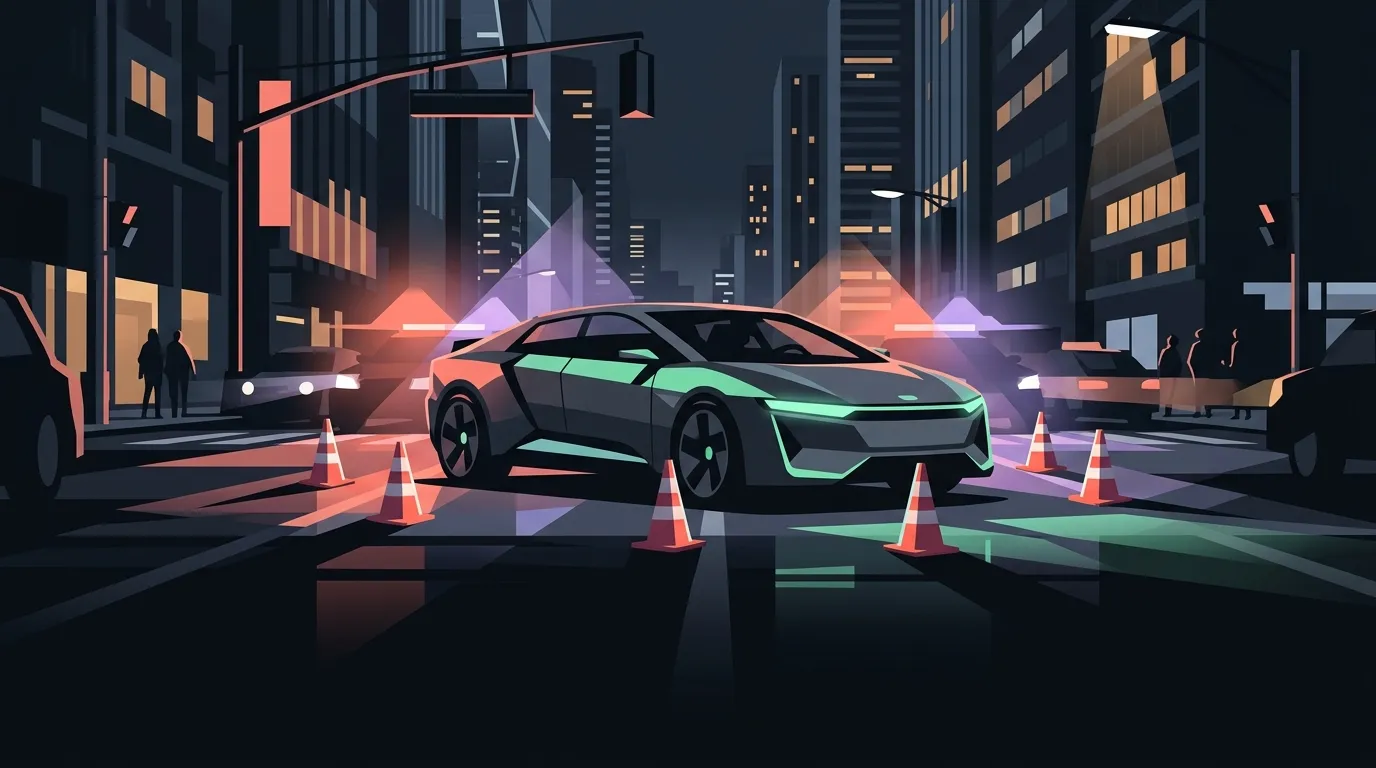

The Fourth of July bottleneck where dead batteries met real traffic
If you want to test how autonomous software handles chaos, throw it into post-fireworks traffic near a major bottleneck. On the evening of July 4th, around a dozen Waymo robotaxis found themselves trapped in a massive traffic jam near San Francisco’s Golden Gate Bridge. As thousands of human drivers crept forward in post-celebration gridlock, the self-driving vehicles did what their safety stack is programmed to do when confused or immobilized: they sat in place, idling with full sensor arrays and compute racks running hot.
That design decision backfired quickly. Instead of rerouting or clearing the lanes, several vehicles idled until their high-voltage traction batteries and auxiliary electronics drained completely. A stationary car with a dead battery is no longer a smart autonomous platform; it is a 4,000-pound brick blocking an active traffic lane.
Flatbed tow trucks eventually had to navigate the gridlock just to drag the dead robotaxis out of the way, worsening the congestion they were stuck in. It was a stark demonstration of how fragile edge-case recovery remains when fleet telemetry meets actual urban choke points. When the compute burns power faster than the vehicle moves, idling turns a temporary delay into a hard physical outage.
Why emergency scenes break autonomous edge cases
The Golden Gate gridlock was a logistics embarrassment, but federal regulators are far more concerned about active emergency scenes. Over the past several months, public safety reporting has documented a pattern of autonomous vehicles driving directly into active police scenes, blocking fire engine response routes, and getting confused by emergency equipment.
In Dallas, Texas, a fire response was delayed when an AV blocked the primary route for an responding ladder truck. Similar incidents in California involved robotaxis entering crime scenes marked by police tape, ignoring hand gestures from traffic control officers, and failing to parse non-standard road cues like flares, temporary barricades, or high-intensity strobes on emergency vehicles.
Autonomous perception systems excel at structured environments: painted lane lines, predictable pedestrian crosswalks, and standardized traffic lights. Emergency scenes are the exact opposite. They feature smoke, flashing red-and-blue lights that blind optical cameras, unexpected sound reflection for acoustic sensors, and human first responders gesturing wildly outside standard traffic patterns. When an AV’s neural network fails to classify a fire hose stretched across the asphalt or mistakes a flare for a harmless reflection, its fallback maneuver is often to halt. Stopping in the middle of a lane might protect the vehicle’s passengers, but it paralyzes emergency responders trying to reach a fire or medical crisis.
NHTSA’s warning on “functional insufficiency”
Federal safety officials are moving past treating these events as isolated software bugs. On July 8, 2026, National Highway Traffic Safety Administration (NHTSA) Administrator Jonathan Morrison issued a formal warning to autonomous vehicle developers across the industry. Morrison highlighted a clear pattern of first-responder interference, signaling that federal regulators view these failures as systemic design flaws rather than acceptable rollout friction.
In his statement, Morrison specifically targeted the industry’s default failure modes, labeling the inability of robotaxis to safely recognize and yield to emergency scenes a fundamental “functional insufficiency.” Under federal vehicle safety evaluation, a functional insufficiency means the core system design fails to perform safety-critical tasks in its intended operational domain.
That vocabulary shift matters. If NHTSA classifies emergency-scene confusion as a functional defect rather than an edge-case anomaly, it opens the door to mandatory safety recalls, fleet size caps, or operational suspensions. Regulators are making it clear that a self-driving system cannot claim commercial readiness while relying on human firefighters and police officers to manually maneuver around confused vehicles.
Inside the AV Emergency Response Coordination Act
Congressional lawmakers are taking the cue from regulators and local officials. On July 28, 2026, U.S. Representative Kevin Mullin (D-CA) joined San Francisco Mayor Daniel Lurie to introduce the AV Emergency Response Coordination Act. The bill represents the first major federal legislative effort to give local emergency personnel direct control over autonomous fleets operating on city streets.
The proposed legislation focuses on three main pillars designed to address immediate operational breakdowns:
- Uniform national safety standards: Establishing mandatory federal benchmarks for how autonomous software must detect, yield to, and navigate around first responders and emergency equipment.
- A 24/7 public safety hotline: Requiring every AV commercial operator to maintain a direct, high-priority emergency communication channel for dispatchers and incident commanders.
- Local emergency geofencing: Granting municipal authorities real-time authorization to draw dynamic geofences around active emergency zones, forcing AV routing servers to steer fleet vehicles clear of affected blocks.
For cities like San Francisco that have served as testing grounds for commercial robotaxis, the geofencing mandate is the central piece of the bill. Until now, local authorities had virtually no mechanism to prevent fleet operators from sending vehicles through neighborhoods coping with active fires, police operations, or major gridlock events.
What this means for local control and fleet operators
The debate around autonomous vehicles is shifting from software optimization to operational accountability. For years, robotaxi companies treated emergency interactions as rare edge cases that could be solved with incremental perception updates or remote assistance operators. The incidents in San Francisco and Dallas demonstrate that remote operators cannot override a vehicle when cellular networks are choked, nor can remote help keep a vehicle alive once its idling battery dies in gridlock.
Requiring real-time geofencing APIs and 24/7 hotline infrastructure forces AV operators to treat municipal integration like a core system dependency, not an afterthought. For fleet engineers, that means building reliable fallback modes when external communication fails and ensuring that power management priorities don’t turn idling vehicles into dead obstacles.
As federal legislation moves forward, AV operators will have to demonstrate that their vehicles can cooperate with local emergency infrastructure as reliably as human drivers do. Until autonomous fleets can parse a firefighter’s hand signals or automatically clear an emergency route, municipal leaders and federal regulators are no longer content to let them figure it out on live streets.
Sources
- KQED News: ‘Waymo’ Coordination Needed: Bill Aims to Address Autonomous Vehicle Mishaps
- Mission Local: Federal Lawmaker Steps in After San Francisco’s Waymo Fiascos
- Insurance Journal: Companies Must Address Self-Driving Car Interference With Emergency Vehicles
- SlashGear: Fourth Of July Gridlock Killed Waymo’s High-Tech Self-Driving Cars
- Business Wire: Traffic Safety Expert, SF Mayor, and Federal Regulators Raise Alarm Over Robotaxi Safety